
Endomorph, mesomorph, ectomorph: knowing your body type is half the way to a great body. Think for yourself, can athletes with different body types train the same way? Obviously not!
Different body types respond very differently to one training program or another. What works for one does not necessarily work for another and vice versa. Each body type requires a separate program and only this will give tangible results in the shortest possible time. If you start training according to your friend’s program, you will do at least 5-6 exercises that are absolutely not necessary, nothing bad will happen: all exercises are somehow good, but how much time will you waste until you finally understand that these are inappropriate exercises. How long can it take to find your exercises? Up to 2 years. At least that’s how most people spend their time figuring out their exercise routine, and then off they go.
By the way, to say that those 2 years were just a waste of time would not be correct, the biggest problem is that during this period athletes often become disillusioned with sport and lose enthusiasm.
Three body types
It is rare to see someone with very specific visible signs. Most often, a given person has all three types of symptoms. In total there are another 88 subtypes, each of which is in some way a mixture of the three main types.
Knowing which of these three types you belong to is not enough to find the optimal training program, so this number has been increased to six by specifying each main type.
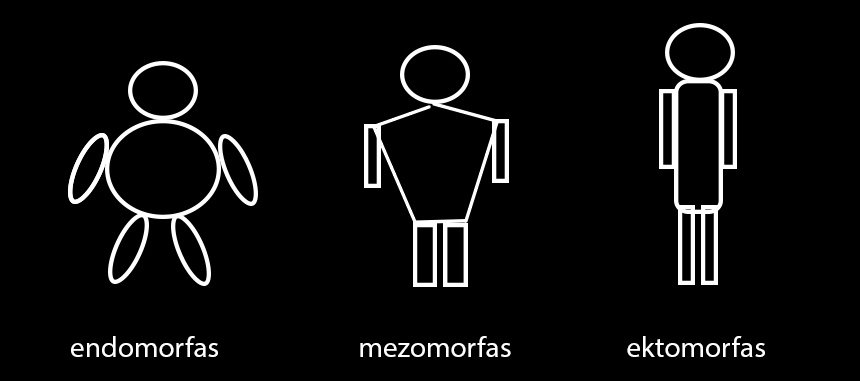
Endomorphs, mesomorphs, ectomorphs
endomorph
A typical endomorph is a large person with a high percentage of fat to muscle, soft muscles, round face, short neck, large legs, and large fat reserves. These people gain weight quickly, as fat usually accumulates on the sides of the abdomen and legs. Unlike ectomorphs and mesomorphs, fat accumulates much faster.
Heavy weight training combined with cardio will be the most beneficial. 2-4 sets of 6-10 repetitions should be performed. The breaks between approaches can be longer (2-3 minutes), which will allow you to work at full speed on each approach. It is more appropriate to play sports according to the “split” methodology. This means that endomorphs need to watch their calorie intake.
Mesamorph
The mesomorph type is an athlete from birth. Broad chest, long body, great strength and large muscles. The mesomorphic physique is best for weight training. Muscles usually start to appear very quickly, especially for beginners.
Recovery between training sessions is usually 3-5 days for the same muscle group, so it is possible to train one muscle group 2 times a week. Most instructors recommend performing 3-4 approaches after 12-15 repetitions, and if you have enough experience, it is recommended to use execution techniques such as: “drop sets”, forced repetitions, supersets.
Ectomorphs
Ectomorphs are characterized by long legs and arms, narrow shoulders and chest, and the muscles are generally long and thin. The metabolism is very fast, so there are no problems with fat, but it is also more difficult to build muscle. To gain weight, ectomorphs must consume a large amount of calories. Taking supplements is essential. Ectomorphs should eat before bed to protect their muscles from catabolism during the night. Ectomorphs can lose fat very easily, making it very easy for them to return to lean muscle mass.
Ectomorph workouts should be short and intense, focusing on large muscle groups. Usually 7-10 days are needed for recovery for each muscle group, back and legs more, other muscle groups less. You should train with medium weights for 10-15 repetitions. Pauses between approaches should be 30-60 seconds to maintain an elevated heart rate.
Your body type
A – type The shoulders are narrow, the pelvis is wide, the impression of a heavy lower part of the body is given by very large legs, by the tendency to accumulate fat below the waist (the upper part of the body can also appear thin); low metabolic rate (if you don’t specifically control your diet, you will gain weight very quickly).
K type Small chest, big legs; gives the impression that the shoulders of the leg and the pelvis are the same width; fat accumulates on the abdomen; normal metabolic rate.
Type I Very thin person, weak muscles, almost no fat; very high metabolic rate (no matter how much you eat, you still don’t gain weight).
O-tips Wide bones, wide pelvis and shoulders, wide legs, ribcage and arms, a clear excess of fat all over the body. Very slow metabolism (seems like you don’t eat at all and the weight keeps increasing).
Type No Broad shoulders, wider than the pelvis; fat remains on the back, chest, sides of the abdomen; average metabolic rate (you only start to gain weight if you start eating more).
Type Medium bones, shoulder width similar to the pelvis, narrow waist, broad chest; fat accumulates on the legs; average turnover rate. (you only start to gain weight if you start eating more).
Look carefully in the mirror and then compare what you see with what is written here. Well, how did you find it? Great if you’ve discovered it – you’ve been waiting a long time at the gym, and if you haven’t yet, try again.
If you combine training and nutrition correctly, you can achieve amazing results, whatever your body type. But people with different types will face different tasks to achieve results, even if their final destination is the same. Don’t forget, the most important thing is patience!
latest posts published

Protein for athletes: TOP questions and answers

What is cardio?

How to lose weight and lose weight correctly?

benefits and possible harms

Exercises for shoulder muscles
Creatine monohydrate: use, suggestions and observations

Health Benefits of L-Carnitine and Other Benefits
Muscle Strength Training (Mike McErlane)

Weight loss: how to get rid of fat?