Exercises for arm muscles (biceps, triceps, forearm)


Exercises for biceps, triceps and forearm muscles do not require special equipment, free weights (dumbbells, dumbbells) are usually sufficient. Hand muscle exercises with simulators are intended for muscle training.

The biceps is tri-jointed, meaning it works through 3 joints. The most important functions are flexing the forearm and bending the elbow.
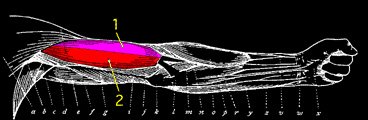
BicepsInternalBicepsInternal

  1. Long heads (external)
  2. Short heads (internal)

The triceps secure the elbow joint when the forearm and hand muscles are engaged, such as during typing. Involved in rotation and adduction movements of the arm.
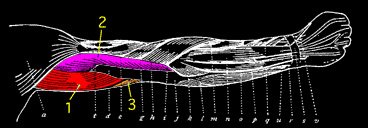
TricepsOutsideTricepsOutside

1. Long heads: Used for shoulder and elbow movements.
2. Side Heads: Used when sudden high intensity movement is required.
3. Internal heads: Used when slower, more precise movements are required.
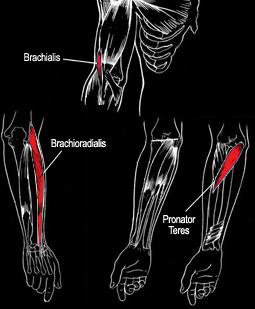
Forearms-Muscle-AnatomyForearms-Muscle-Anatomy

The forearm muscles surround the forearm bones. These are mainly long muscles. Their belly is more proximal, closer to the upper arm, and the long tendons run down to the fingers, so the distal end of the forearm is significantly thinner. The anterior and posterior muscle groups are distinguished.

On the front are the hand and finger flexors and the muscles that rotate the forearm inward. There are superficial and deep layers. Most flexor muscles attach to the radius or hand bones.

The muscles of the posterior group extend the hand and fingers, retract the thumb, rotate the forearm outward. There are superficial and deep layers.

Biceps exercises
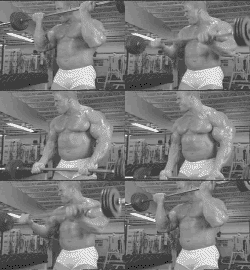
Standing with a barbellStanding with a barbell

Standing with a barbell

The main load falls on the biceps muscles. The anterior part of the deltoid muscles and the muscles of the forearm (especially the radius muscle of the humerus) are also loaded.

Preparation
Stand up straight, grab a barbell shoulder-width apart.

Performance
Raise the bar until your arms are fully bent, then lower them until they are fully extended.

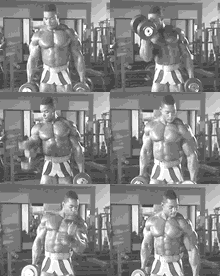
Stand with dumbbellsStand with dumbbells

Stand with dumbbells

The main load falls on the biceps brachii muscles (their central part). The anterior part of the deltoid muscles and the muscles of the forearms are also loaded.

Preparation
Stand straight, take 2 dumbbells

Performance
Raise one arm to your shoulder, then fully extend it again, then raise the other arm.

Comments
Slowly lower your arm so that the weight does not bend your elbow to the other side due to inertia and thus injure it.

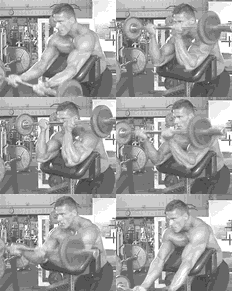
Larry the Scotsman with a barbellLarry the Scotsman with a barbell

Larry the Scotsman with a barbell

The main load during the exercise falls on the lower part of the biceps muscles (at the elbow). The middle and upper parts of the biceps brachii muscles and the muscles of the forearms are also loaded.

Preparation
Sit on the specs. bench, place your hands up to the elbows on the support, grasp the barbell shoulder width apart.

Performance
Bend your arms until they are almost vertical with your hands on the support, then fully extend them again.

Comments
The muscle is worked more when you bend your arm from the starting position to 90 degrees.

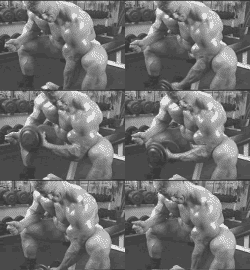
Leaning on his kneeLeaning on his knee

Leaning on his knee

The main load during the exercise falls on the lower part of the biceps muscles (at the elbow). The middle and upper parts of the biceps brachii muscles and the muscles of the forearms are also loaded.

Preparation
Sit on a bench, take a dumbbell in one hand, rest your elbow on your knee, your legs should be slightly wider.

Performance
Raise the dumbbell to your shoulder, then lower it again. Next, repeat the exercise with the other hand.

Rope with one handRope with one hand

Rope with one hand

Preparation
Stand in front of the machine with the rope from below, take the rope with (the ring) in one hand. The arm should be close to the side.

Performance
Bend your arm until it is fully bent, then lower it again until it is fully extended. Next, repeat the exercise with the other hand.

Triceps exercises

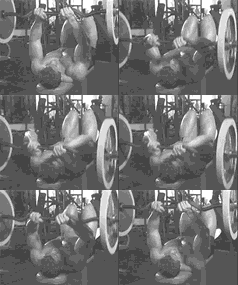
Narrow barbellNarrow barbell

Narrow barbell

The main load during the exercise falls on the triceps muscles, with a greater load on their internal part (long heads). The anterior part of the deltoid muscles and forearm muscles are also loaded.

Preparation
Lying on a bench, grab a barbell about 8 inches wide and hold it above your chest.

Performance
Raise the barbell until your arms are fully extended (keep your elbows at your sides), then return to the starting position.

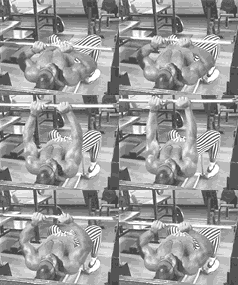
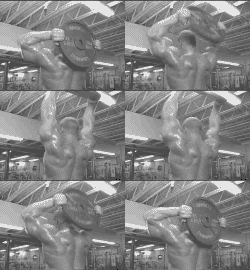
French pressureFrench pressure

French pressure

The main load falls on the triceps muscles.

Preparation
Lie on a bench, take a narrow barbell and raise it above your head, your arms should be extended.

Performance
Lower the barbell by bending your arms at the elbows, when the barbell almost reaches your head, bend your arms slightly to lower the barbell well without obstructing your head, then bend your arms again until they are fully extended. Repeat the exercise like this.

Comments
After fully extending the arms, the barbell can be returned to its original position above the chest. The shoulders can be rolled inward differently between repetitions to release tension.

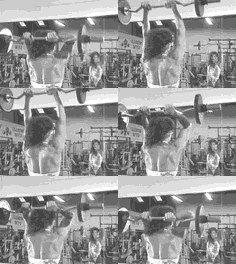
Seated French pressSeated French pressSeated French pressSeated French press

Seated French press

The main load falls on the triceps muscles.

Preparation
Sit on a bench (the bench may have a backrest), grip a barbell or weight tightly and lift it above your head.

Performance
Lower the barbell/weight behind your back by bending your arms at the elbows, which should remain above your head, then raise the barbell/weight above your head again until your arms are fully extended.

Comments
Allow the barbell to pull your arm back to maintain full shoulder flexion.

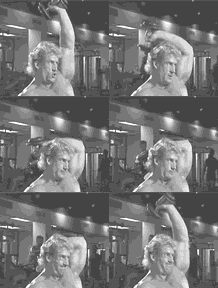
Sitting triceps with one armSitting triceps with one arm

Sitting triceps with one arm

The main load falls on the triceps muscles.

Preparation
Take a dumbbell, lower it behind your neck, your elbow should be pointing up.

Performance
Extend your arm until it is fully extended, then return it to the starting position.

Comments
The bench can have a low back, allowing the dumbbell to pull the arm back to maintain full shoulder flexion.

Push-ups on the benchPush-ups on the bench

Push-ups on the bench

The main load falls on the triceps, chest and front part of the shoulder muscles. In addition, the muscles of the chest and front of the shoulders are loaded.

Preparation
Place 2 benches next to each other in about half a meter, put your hands on the edge of the bench, put your feet on the other edge of the bench, if there is a need you can put the weight on your legs.

Performance
Lower your body until it is fully extended or until your tailbone touches the ground, then raise yourself until your arms are fully extended.

Forearm exercises

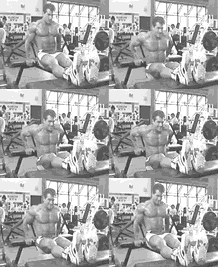
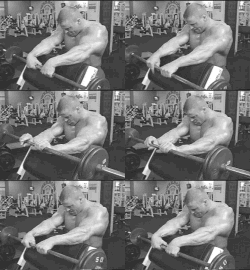
Barbell curlsBarbell curls

Barbell curls

The main load falls on the flexor muscles of the forearm.

Preparation
Sit on a bench, take a barbell shoulder-width apart, rest your forearms firmly against your legs, wrists should be on your knees.

Performance
Let the barbell roll from your palms to your fingers, squeeze the barbell and bend your wrists.

Comments
Keep your elbows at wrist level to maintain resistance throughout the entire range of motion.

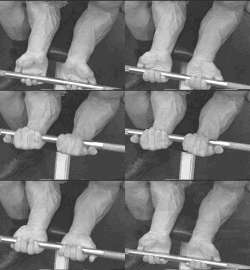
Rocker constructionRocker construction

Rocker construction

The main load is received by the extensor muscles of the forearm.

Preparation
Sit on a bench, take the barbell shoulder-width apart, place your forearms firmly against your legs, wrists should be on your knees.

Performance
Fully extend your wrist to 180 degrees, then lower it.

Comments
Keep your elbows at wrist level to maintain resistance throughout the full range of the exercise.


latest posts published

Protein for athletes: TOP questions and answers
Protein is one of the main macronutrients needed by the human body, especially for people who play sports. The importance ...

What is cardio?

Many people do not understand or simply do not want to understand the benefits of cardio training, they do not ...

How to lose weight and lose weight correctly?

Often in the press there is talk of another miracle diet for losing weight or a quick weight loss diet ...

benefits and possible harms

Creatine is a substance found in skeletal muscles that plays an important role in producing energy for the body in ...

Exercises for shoulder muscles

Shoulder muscle training exercises and their characteristics. The main muscle of the shoulder is the deltoid (deltoid) muscle, which is ...

Creatine monohydrate: use, suggestions and observations

There are various sources that advocate different regimens for creatine monohydrate. Since research and practice in this area are somewhat ...

Health Benefits of L-Carnitine and Other Benefits
Regardless of what your goals are in sports: building muscle or losing fat, L-carnitine will certainly come in handy in ...

Muscle Strength Training (Mike McErlane)
There are many philosophies on how to increase strength, every expert has their opinion, but I don't care who says ...

Weight loss: how to get rid of fat?

When it comes to losing weight, fasting seems like the easiest and fastest way to lose fat, but every pound ...

All about creatine: what it is, benefits and uses

Creatine is one of the most popular dietary supplements among athletes, used by both professionals and amateurs. It helps increase ...

Leave a Reply

Your email address will not be published. Required fields are marked *