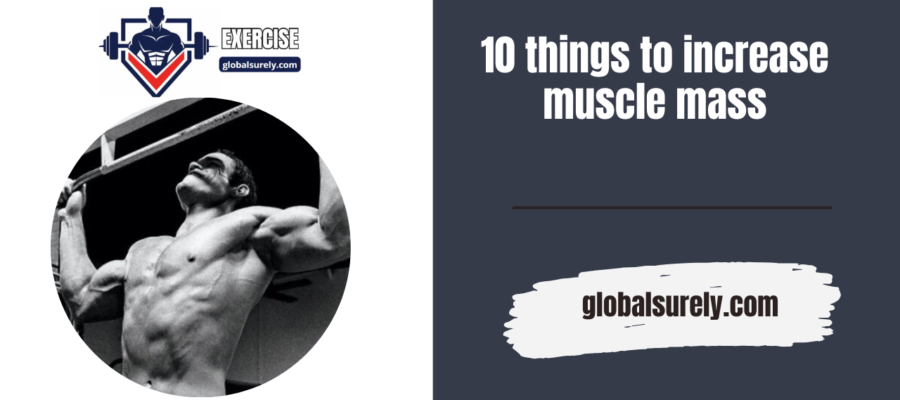
These 10 tips are essential for building muscle mass. In other words, it’s the key to your success in building muscle mass!
What does it take to increase muscle mass?
1. Weight training
Weight training involves equipment that allows for a variety of resistances. By “resistance” we mean free weights (barbell, dumbbells), machines that work on the torso or pulley principle (which help lift the weight), and bodyweight exercises such as pull-ups or lunges.
Anyone who wants to build muscle mass needs to do a few things. First train with heavy weights. By big weights I mean think big weights for YOU! The average man in the gym usually works with weights that he can lift for 10-15+ repetitions. It’s too much to gain weight. Using the right weights, you should be able to perform 4-8 repetitions. And that’s all! When working with heavy weights and performing low repetitions, your system puts much more “stress” on your muscles and nervous system than training with lighter weights and high repetitions. This stress engages and stimulates muscle fibers, causing rapid muscle growth.
Maximum muscle growth is mainly influenced by free weight exercises. No exercise machines or body weight exercises. I’m not saying you shouldn’t use machines or bodyweight exercises, but they shouldn’t be the focus of your workout. For a workout that damages your muscles most effectively, you need to stimulate as many fibers as possible, and exercise machines don’t do that.
The main reason for this is the lack of development of the stabilizing and interacting muscles. The stabilizer and co-acting muscles are the “assistant” muscles that help the lead muscle do the heavy lifting. Free weight exercises like the bench press require the help of many stabilizing and cooperating muscles to perform this exercise. In other words, a fixed bench is unlikely to engage your stabilizing muscles.
2. More calories
The biggest thing I can’t stress is eating to gain weight. You have to eat like you’ve never eaten before. If you don’t eat enough calories, you will NEVER gain weight, no matter what you do. To build muscle, you have to eat more calories than your body burns, creating what’s called a calorie surplus. When gaining mass, you should aim to eat around 40-45 times your body weight in calories. The extra calories will be used to “repair” muscle tissue damaged during hard training and to build new muscle.
Now yes, when I say eat I don’t mean just anything. Not all calories are created equal. In other words, some calories aren’t that important for building muscle. For example, if I tell you that you have to eat 2,000 calories a day to gain weight and you eat 4 bags of chips every day, do you really think you will gain muscle? I don’t think the vast majority of your weight is fat. Why? Because chips, like most “waste food”, have no useful calories. Such food does not provide the calories needed for muscle growth.
3. More protein
Without protein, your body simply can’t build muscle. Many years ago, a low-carb diet was the latest fad recommended by professional bodybuilders and trainers. They claimed it was the only way to build muscle. Unfortunately, the only people who followed that diet and were able to build muscle were genetically gifted. Others simply gained weight.
Carbohydrates serve to provide energy to the body, while proteins provide the amino acids necessary for building and repairing muscles. Carbohydrates are less important than protein for muscle growth. The basis of your meals should be high-quality protein, which the body breaks down into amino acids. There have been many studies that have shown that intense exercise increases the need for amino acids that build and repair muscles. If you want to build muscle, you should get at least 2.2 g of protein per kilogram of body weight.
Believe it or not, the facts are the facts: protein diets build more muscle when followed by vigorous exercise. Low protein diets: NO! Only protein can build muscle tissue. Carbs and fats can’t do that.
4. More frequent meals
If you want to gain weight, you will eat large amounts of calories. Unfortunately, your body can only absorb a certain amount of calories per meal. Therefore, eating 3 times a day is useless. If you need to eat 3,000 calories a day, you will eat 1,000 at each meal. The average person can only absorb a fraction of those calories. The excess will be stored as fat or removed from the body.
To force your body to actually absorb and use the 3,000 calories you ingest, you need to reduce the size of a meal and increase the number of meals. Breaking calories into smaller but more frequent portions will improve food absorption and utilization. I always eat 6 times a day, with about 3 hours between meals.
My goal is to have a body full of energy throughout the day. So, if the body needs about 2.5 hours to digest most meals, the next meal should be the one in which the last food leaves the stomach. I do this because my body always needs substances to repair itself. I do a lot of damage during training and the body is stressed. The body tries to adapt to stress, but it constantly needs constant fuel to succeed.
If I ate only 3 times a day, my body would be without the necessary substances for about 6 hours between meals. This is not acceptable for skinny guys. Without food, your body quickly begins to break down muscle tissue for energy.
5. More fat
If you want to gain muscle mass, you need to eat enough fat. Fat plays an important role in the production of hormones responsible for growth and strength. I’ve never gained muscle mass on a low-fat diet, but many people still believe that eating fat will make them gain weight. This is complete nonsense. In fact, there has been a very popular muscle-building diet called the “anabolic diet” that requires you to eat only fat for years! Butter, pork and other fatty foods are part of that diet. Although it seems strange, this diet really works.
Most people are overweight simply because of a simple carbohydrate diet, not because they eat fat. If your diet doesn’t provide enough fat, your body starts storing the fat it gets because it doesn’t know when it will get it next. A low-fat diet will also lower testosterone levels, which we certainly don’t want when trying to gain weight. Studies have shown that fat has a direct relationship with testosterone production. Increasing the amount of fat intake also increases testosterone levels. The opposite is also true. Reducing the amount of fat from food also reduces the amount of testosterone.
Either way, you don’t want to increase your saturated fat intake. Saturated fats cause disease. While you will always have saturated fat in your diet, your main goal should be to increase your intake of essential fatty acids.
Essential fatty acids are unsaturated fats needed for thousands of functions in the body. Since they cannot be produced by our body, they must be obtained through the diet. These fatty acids not only help increase testosterone production, but they also heal by preventing muscle atrophy, help increase HDL (good cholesterol) levels, and are involved in hormone production.
6. More water
To ensure your muscles stay hydrated, you need to drink plenty of water. Dehydration can occur easily if you train hard. A dehydrated muscle takes longer to repair than a properly hydrated one.
Drinking enough water not only increases the visibility of your veins but also helps to quickly remove toxins from the body. Proteins release metabolic waste products that must be dissolved in water. Without adequate amounts of water, the kidneys cannot effectively eliminate these granules.
7. Multivitamin
If you want to gain quality weight, you need to make sure that you are not lacking in vitamins and minerals that your body needs. I know people who would disagree with me, but believe me, nowadays we need to supplement our diet with vitamins and minerals. Those who are against vitamins say: “eat a balanced diet and you will be fine…”. However, today’s food is mostly lacking in vitamins and minerals compared to that of a hundred years ago. Now we eat almost no vitamins and minerals, vegetables grown on impoverished soils fertilized with pesticides.
Most multivitamin manufacturers try to put “everything” in their products, but this is not necessary. Multivitamins must contain the recommended amount of vitamins A, B-complex, C, D, E, K and the minerals calcium, magnesium, zinc, iodine, selenium and iron (for women). Men should find iron-free multivitamins. You usually get more than you need from food. An additional amount of iron is necessary only for menstruating women. Of course, multivitamins must also contain other important elements such as biotin, manganese, chromium, copper, molybdenum.
Magnesium, zinc and calcium compete for absorption, as does copper with zinc. But let’s think about it for a moment. After all, it’s exactly like eating different foods, which most people do. Vitamins and minerals also compete in foods. The body awaits the “competition” and copes with it as best as possible.
8. Antioxidants
The antioxidants vitamins A, C, E, glutathione, glutamine and selenium are key to preventing free radical damage, which is accelerated after weight training. Antioxidants protect other substances from oxidation.
9. Rest
If you don’t rest, you won’t grow! Your body builds muscles when you rest, not when you train at the gym! The formula for successful weight gain is to eat enough calories, train hard, and rest.
Dietary changes will never make up for a lack of rest. If you work hard in the gym, you should give your muscles as much rest as possible. If you don’t give them time to rest and recover, you simply won’t grow!
10. Consistency
Do you want to know the secret on how to gain muscle mass quickly? Here it is: SEQUENCE! You can have the best diet, the best workout program, go to the best gym, but without consistency everything is useless.
You have to be determined and constantly take steps one after another to achieve your goal. If not now, then when? “You will never know what you can do until you try to do more than you can.” —Tony Blauer
latest posts published
Protein for athletes: TOP questions and answers
What is cardio?
How to lose weight and lose weight correctly?
benefits and possible harms
Exercises for shoulder muscles
Creatine monohydrate: use, suggestions and observations
Health Benefits of L-Carnitine and Other Benefits
Muscle Strength Training (Mike McErlane)
Weight loss: how to get rid of fat?