Have you ever had the feeling that after sitting for a long time, you start to feel back pain in the evening? To prevent this from happening, we suggest replacing your office chair with an exercise ball. In this article, you will learn why an exercise ball is a great piece of equipment and how to use it.
in 1963 the exercise ball was invented by the Italian Aquilino Cosani. They were initially used to treat infants and young children and have since spread throughout the world as a physiotherapy tool. With their training, physiotherapists have created an arsenal of exercises that are used today in aerobics, pilates and many other sports.
What is an exercise ball?
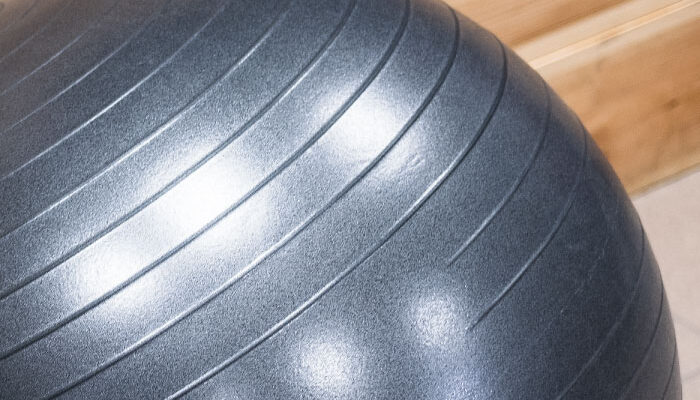
Air-filled exercise balls or fitness balls are effective tools for increasing daily physical activity. They are mainly used for various rhythmic gymnastics and pilates exercises, but also for light sessions.
Who needs the exercise ball and what does it help to train?
The exercise ball is a completely universal training tool, suitable for everyone – from children to the elderly, from office workers to top athletes. The main purpose of ball gymnastics is to develop balance. It also trains your body muscles and improves coordination. Even for those with less of a sense of balance and coordination, an exercise ball is a great exercise tool. Balancing on a ball helps train the muscles of the body.
For those who are bored with the usual abdominal exercises, the exercise ball is a good opportunity to perform the same exercises in a new way. Doing it on the ball will make these exercises much more difficult, so even a normal session can become much more effective.
Sitting on an exercise ball in the office will definitely improve your posture over time, helping to prevent and reduce muscle strain and back pain. Researchers conducted a study with exercise balls on elementary school students who had difficulty concentrating in class.
It has been observed that students sitting on an exercise ball are more focused and focused on learning, therefore exercise balls can also be used in children’s institutions.
Exercise balls of different sizes
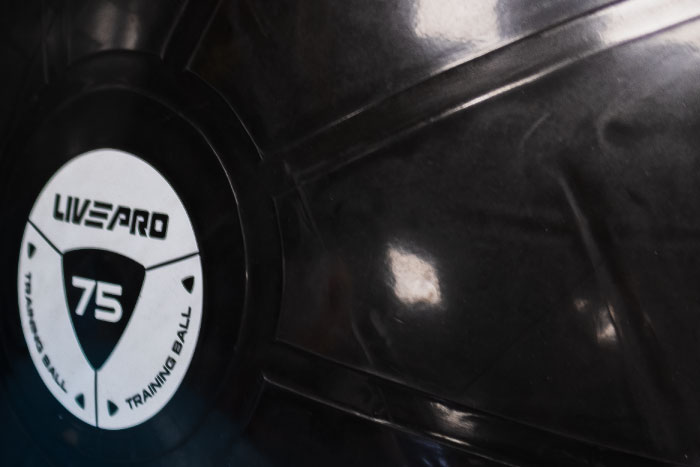
There are four common sizes of exercise balls: 55cm, 65cm, 75cm and some brands also offer 85cm. diameter spheres. The choice of size depends on what and for which exercises the ball will be used.
In addition to gymnastics, the fitness ball can also be used very successfully every day, for example while sitting at your desk in the office. In this case the choice of the size of the ball depends on the height of the person. It is easy to choose a ball according to this formula, for example 55 cm. the diameter ball fits up to 155cm. height, 65 cm. diameter – up to 165 cm. height, 75 cm. diameter – up to 175 cm. height and 85 cm. The diameter ball is suitable for people over 175cm tall.
Which exercise ball to choose?
The size of the ball is important because people want to use it while sitting at the table. An employee can use an exercise ball instead of a chair every day. However, it is very important that the ball is the right size, as an incorrectly sized ball can create an ergonomic position, for example the person sitting on the ball is too high or too low and the position of the arms and legs in relation to the table and ground is incorrect.
If you can’t choose the right ball yourself, please contact the service staff of the Budopunkt online store directly, who will recommend the most suitable inflatable gymnastic ball for you.
If you want to use the exercise ball mainly for training purposes, the choice of size also depends on the nature of the exercises, but you can always refer to the formula above.
What should you look for when buying or using an exercise ball?
First, the new balloon is not inflated in the package, so in most cases you will find a small pump in the package. If you have, for example, a bicycle pump at home, the balloon can be inflated much faster.
Before buying, check whether the ball comes with a pump, because inflating the ball yourself like a balloon is a rather complicated and time-consuming process. Most often in the kit you will find a small hand or foot pump, but it is useful to have an electric pump with which you can inflate the ball faster.
Buyers also often wonder how much air should be pumped into an exercise ball.
The amount of air is mostly cognitive, but it is not necessary to inflate the exercise ball to maximum hardness. When sitting, the exercise ball should lower to the knee joint and form a right angle.
From time to time, the ball may be slightly inflated, as it may lose some air over time. Keep in mind that the more inflated the ball, the more difficult the exercises will be. A softer ball ensures greater contact with the ground, making exercises easier.
Temperature can affect the air pressure inside the ball. The ball loses pressure at lower temperatures and expands slightly at warmer temperatures, so it is worth monitoring the air pressure in the ball from time to time and, if necessary, inflate or, conversely, reduce the air pressure. When performing exercises or sitting on the ball, it’s a good idea to rotate the ball regularly to avoid wearing out one area faster.
It is definitely worth rotating the ball regularly when doing exercises or sitting on the ball to avoid faster wear of a point.
However, if you have never been exposed to exercise balls, it is a good idea to go to a sports club, such as a training group, to try them out before doing exercises at home. In this way the first exercises and the correct execution technique will become clear under the supervision of the trainer.
Exercise balls are still widely used in rehabilitation and physical therapy. In this case, the physiotherapist will certainly show the initial exercises himself and can also give advice on choosing the ball.
How to choose the right size of training ball, taking into account your height?
- A general guide to standard sizes:
- 45cm – 152cm or less *
- 55 cm – new 153 cm and 173 cm
- 65cm – 175cm – 188cm
- 75 cm – new 190 cm and 200 cm
- 85cm 202cm or larger
- Choose a larger ball if:
- – You are overweight;
- – You have longer legs;
- – Complaints of back pain;
- – If you want to use the ball as an office chair. Be sure to determine the ratio of the length of the table to the size of the ball.
- Choose a smaller ball if:
- – You have shorter legs.
Worth knowing: The balls marked with ANTI-BURST, which means the punctured ball will not explode immediately, but the air will come out little by little.
Alternative products
Pilates ball
A pilates ball or redondo is basically a mini version of a large exercise ball. The ball is commonly used in MindBody, pilates, wellness and fitness training.
Just like a large exercise ball, the pilates ball can be used to make exercises more difficult by applying more air or ground pressure.
The more you inflate the ball, the harder you can train, which allows you to increase stamina, coordination and concentration.
The Pilates ball is available in various sizes, ranging from approximately 15 to 30 cm. Usually the ball also comes with a small hand pump, but since the ball is small you can inflate it without much effort.
Bosu balance ball
Balance balls, shaped like half a ball with a solid, hard bottom, are also a type of exercise ball.
Budopunkt also features balance balls with attached elastic rubber and handles which further increase training effectiveness.
The term Bosu derives from the English term Both sides up which means using the tool in two ways
While standing on the ball you pay close attention to maintaining your balance and you can also use aerobic steps.
If the Bosu is turned upside down, you can rely on its smoothest part, for example, to bend the arms with rubber bands, which will certainly increase the load.
Supervision
The exercise ball is almost maintenance-free. If the exercise ball is used by several people, it is necessary to clean it from time to time. It is also worth paying attention to the fact that although gymnastic balls are made in such a way that if they come into contact with a sharp object, they will not immediately explode with a bang, but will slowly lose air, so we advise you not to keep sharp objects near the ball.
When storing an exercise ball indoors, it is recommended to protect it from constant direct sunlight, as the material becomes more elastic over time.
latest posts published
The best bodybuilding exercises to sculpt a stronger physique
Jumper: how to find the one best suited to you? (+ useful tips for choosing)

How to start training and not burn out: a healthy approach to movement and progression
How to build a gym at home

Amber CrossFit × CrossFit OPEN 2026
Is CrossFit training dangerous?
What do you need to know when choosing an exercise ball?
Nutrition for athletes, where to start?
Deadlift: benefits, technique and how to perform it correctly