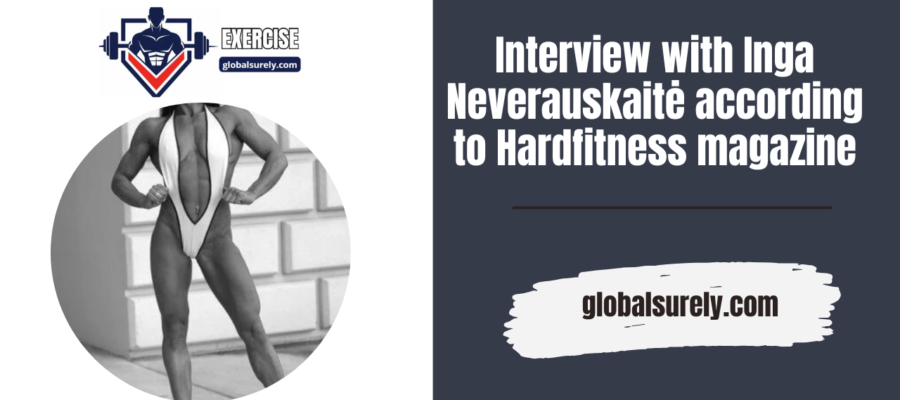
1) Introduce yourself. What makes you unique? Who is Inga Neverauskaitė?
I don’t consider myself special or exceptional. Inga Neverauskaitė is me, a person with standard desires who strives to perform at her best in all life situations, taking into account those around her.
2) Can you tell us a little about your family, your friends, the people around you?
My parents still live in Lithuania, while my sister lives in London. My husband Robert and I visit them whenever we can. We live in Mansfield (county of Nottinghamshire), a town located in an area of former coal mines. This town is located on the edge of Sherwood Forest, famous for being the hideout of the famous thief Robin Hood. We often take our Toy Terrier puppy Timmy there for a walk. We have many friends both from England and local Lithuanians. Communicating with them suppresses homesickness.
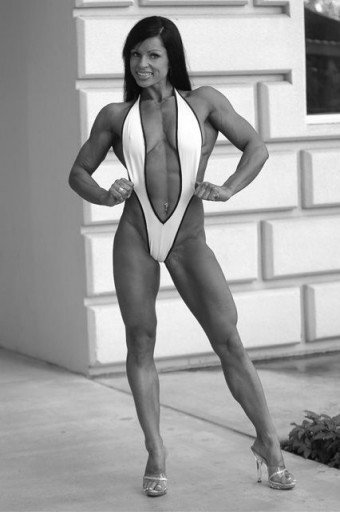
Inga Neverauskaite
3) How did you start participating in competitions?
The beginning of everything is fitness. I got my professional card after winning the British Fitness Championships. Even though I had the basics of fitness, I knew I would never be fit enough to match the exceptional level of fitness girls in the United States. These girls are unique! I decided to try my hand at figure competition and have never looked back.
4) What is your personal approach to overall appearance and muscularity in preparation for a performance? Do you like a “softer” or “harder” look?
I like a more muscular look where all the muscles are seamlessly visible, but I also think symmetry and performance are very important.
5) What do you think the judges ask of the “Figure” participants? Do they always communicate to competitors what is required of them? In Canada it turned out that they understand each other very well, unlike in the United States.
I’m still not sure what the judges rate the contestants. There is always an obvious difference in muscle size and fitness between award winners.
6) What will you need for upcoming shows? Psychological/physical preparation? Is there something?
I will continue to work in all sectors. There are no limits to personal improvement.
7) What is your typical training day like? Do you do a lot of cardio before shows?
I train according to a 4-day split, each body part once a week. The number of repetitions is 8-15 for 3-4 approaches and 3-4 exercises per body part. Before the race I start training with 20 minutes of cardio 4 times a week and gradually increase up to 45-60 minutes 6 times a week.
8) How is your diet?
The diet depends on my preparation, the duration of the race and the breaks between one race and another. The week before this year’s Olympia, my diet consisted of only turkey, rice, vegetables and some fruit.
9) How do you regulate your fluid intake? Let me be specific.
The day before the race I drink about 6 liters of water. On race day I only sip it when I really need it.
10) What motivates you to train, diet and compete?
My main goal is to improve. Many professional girls inspire me to strive for the highest standards.
11) Tell us some interesting events from the last competition.
I met Bill Dobbins who did a photoshoot in Red Rock Canyon. It was an amazing experience.
12) What is your opinion on the entire fitness and bodybuilding industry? Maybe you would like to change something?
I would definitely increase the number of figure competitions in Europe. I would give more opportunities to European women to compete and become famous. Traveling to the US is really expensive to attend good competitions.
13) Which of all your previous performances do you think is the most impressive and best?
In 2004 in California. It was my first professional competition in America.
14) Did you change your preparation before the 2007 Olympia?
I worked harder than ever. My body wasn’t responding as I expected, so I added more cardio and changed my workout routine to 2 days of supersets. The diet was much stricter. I have never cut carbs as low as I did this year before this race.
15) What do you think of the 20% rule that the IFBB has proposed for female athletes? Why do you think they did this? Do you think participants will stick with it? Will it fly away?
I honestly don’t know much about it. I think it will simply disappear and all talk will be silenced. Maybe someone will follow these rules, maybe the judges will finally start to appreciate slightly more muscular girls… Who knows?
16) What are the main differences between competitions in Lithuania and the United States?
In Lithuania the atmosphere is slightly different, because there are no language barriers. American girls are much friendlier, but charm plays a more important role than in Europe.
17) Tell us how you grew up and did you have any interesting experiences in your youth?
Coming from another country which is located in the eastern part of Europe, you had to experience many different things.
Yes, there are many differences between Lithuania and the UK. Some better, some worse. The latter is reflected in the increase in the cost of living. There is a very big difference between the rich and the poor. People are more closed and reserved.
Lithuanians have much more natural eating habits, without fast food on every corner. In the UK, even small towns are influenced by industry and when you go out you don’t smell that smell like you can in your hometown.
I had a very happy childhood in Lithuania. I grew up in a loving and caring family. My sister and I were often taken to the theater and ballet, and we often went on picnics. The summers were very hot and the winters very cold, but I liked both seasons. Many of my classmates had similar interests to me, so we were in good company.
I was raised to accomplish everything I could with my own strength. This helped me gain self-confidence. However, in England, children are obviously spoiled and given many material things that they desire.
18) Have you exercised before? Gymnastics, football, volleyball or something else?
I have been active since childhood. I danced, attended aerobics and gymnastics
19) What is your typical day like?
I usually have breakfast at 8 in the morning. Then, after training, I come home, answer letters, clean the house until lunch time. I get ready and leave for work at 1pm. I return around 9pm, then I have 8 hours to sleep.
20) What is your profession now?
I work for Allied Boots, who supply medical products to both the UK and Europe. My job involves collecting and checking orders. All work is very strictly controlled.
latest posts published

Protein for athletes: TOP questions and answers
What is cardio?

How to lose weight and lose weight correctly?

benefits and possible harms
Exercises for shoulder muscles
Creatine monohydrate: use, suggestions and observations
Health Benefits of L-Carnitine and Other Benefits
Muscle Strength Training (Mike McErlane)
Weight loss: how to get rid of fat?