

SME Liability Protection Canada: Safeguard Your Business

You run a busy neighbourhood bakery and one morning a customer slips while you are short‑staffed. The same week, a ransomware note freezes your till. These hits feel personal, but they also expose gaps in how your business manages everyday risks.
In this guide you get straightforward, expert advice on what insurance protects and how coverage fits into your day. We explain core options so you can keep serving clients without jargon.
You’ll learn where risk hides from slips to cyber attacks and when a trusted broker can help secure the right products and a fast quote for cyber coverage. Our focus is practical steps that balance cost and resilience so your company keeps moving forward.
Table of Contents
- What SME liability protection means for your Canadian business today
- Map your biggest risks before you buy coverage
- Core coverages to consider in a Buyer’s Guide
- SME liability protection Canada
- How to buy: broker advantages vs. direct insurers
- What it costs and how to save without creating coverage gaps
- Secure your next step: tailor coverages, compare quotes, and protect your growth
What SME liability protection means for your Canadian business today

A simple mistake in a client report can trigger a costly claim that stalls your daily work. Your insurance should act like a safety net so you can focus on customers and growth.
Defining it in plain language
Liability protection means your policy helps cover third‑party costs when your operations cause injury, damage, or reputational harm. It pairs with liability insurance that also pays defence costs if allegations arise.
Why now: changing risks
Canadian SMEs face economic shifts, rapid tech adoption (including AI), supply chain shocks and cyber threats. These trends raise claims and financial risks, so your coverage must evolve with your operations.
Who needs this
Contractors, retailers, restaurateurs, service firms and home‑based professionals all need tailored insurance. Core pillars are Commercial General Liability, E&O for services and D&O for leadership decisions.
- Combined policies and broker guidance save time and avoid gaps.
- Right‑sized limits shield your balance sheet and reputation.
- For practical next steps, see how business insurance safeguards small businesses.
Map your biggest risks before you buy coverage

Start by tracing the touchpoints where your business faces the biggest exposures. A clear map shows where a policy helps and where gaps remain.
Operational exposures to list first
- On-site injury: public walkways and worksites can produce a costly slip or trip claim.
- Property damage: your work may harm client property, or your assets may be at risk from fire or storms.
- Cyber and supply chain: data breaches, equipment failure, and delayed suppliers create cascading financial risks.
Real-world impact and how to prioritise
Put numbers to your map. A single slip‑and‑fall lawsuit can exceed $300,000, and general liability claims rose to $4.3B industry‑wide last year. These figures show the cost of being underinsured often outweighs premiums.
- List failure points in operations, data handling and third‑party services.
- Match each exposure to the policy that responds and note common exclusions.
- Rank the top three exposures by impact and likelihood, then set target limits and deductibles.
| Exposure | Typical response | Common exclusion |
|---|---|---|
| Bodily injury (public) | Commercial General Liability | Employee workplace injuries (WSIB) |
| Property damage (client or own) | Property & CGL | Professional errors (need E&O) |
| Cyber attack / data loss | Cyber insurance | Unpatched systems or excluded malware |
| Supply chain delay | Business interruption / contingent BI | Secondary suppliers without named coverage |
Work with a broker or use a guided assessment to ensure your map is complete. For cyber risk specifics and coverage options, see this business cyber risk coverage guide.
Core coverages to consider in a Buyer’s Guide
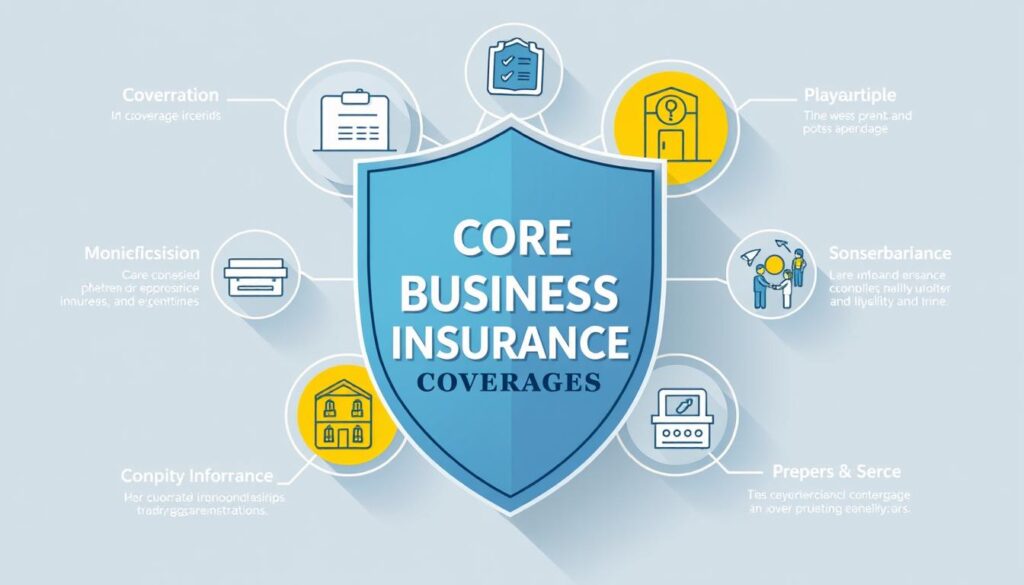
Think of coverages as tools: each one fixes different threats to your daily operations and reputation. Use this quick guide to match a risk to the right policy so you buy with confidence.
Commercial General Liability
Commercial general liability covers third‑party bodily injury, property damage and personal or advertising injury. It pays defence costs, settlements and judgments tied to your products, services or operations.
Professional Liability (E&O)
Professional liability (E&O) addresses errors, omissions and negligent advice that general liability excludes. If you deliver services or advice, this coverage is essential.
Directors & Officers (D&O)
D&O helps protect leaders’ personal assets when decisions are challenged. It supports retention and risk‑taking by shielding directors from certain legal costs.
- Property insurance & business interruption: replaces damaged assets and lost income after a covered loss.
- Cyber insurance: pays breach response, data restoration, ransomware costs and related first‑party losses.
| Key exclusion | Typical response |
|---|---|
| Employee injuries | WSIB / workers’ compensation |
| Commercial auto incidents | Commercial auto policy |
| Professional errors under CGL | Errors & omissions (E&O) |
Consider combined policies and tailored endorsements. Talk with a broker to align limits, sublimits and retroactive dates so your insurance policy reflects how you deliver products and services.
SME liability protection Canada
Regional rules and client contracts can change what your policy must cover. Start by checking provincial licensing notes and venue demands so you don’t face surprise refusals at permits or events.
Province-by-province nuances you can’t ignore
Ontario often expects at least $2M general liability for contractors. Retail and hospitality may need higher limits due to frequent slip‑and‑fall claims.
Ontario, British Columbia, Alberta, Quebec: examples and endorsements
- British Columbia: $2M commercial general liability is common; consider earthquake endorsements.
- Alberta: Event vendors usually need $2M GL and should address hail/wind exposures.
- Quebec: Require French policy documents and watch advertising injury rules; professional liability remains separate.
- Across provinces, landlords and venues often ask for certificates naming them as additional insureds and specific limits.
- If you sell or install products, confirm completed operations and products liability match your work.
- A broker can interpret local rules, recommend endorsements, and align policies to municipal and client terms.
How to buy: broker advantages vs. direct insurers
Decide whether speed or market reach matters most for your business. A short intro helps you choose the right path for your risks, contracts and growth plan.
When a broker makes sense
Choose a broker when you need access to 50+ insurers, negotiation power on terms, and tailored endorsements that reflect provincial rules and contract demands.
- A skilled insurance broker compares policies side by side and highlights exclusions, sublimits and costs so you know what you’re buying.
- Brokers often bundle general and professional liability with legal coverages into one tailored policy for more complex operations.
- Ask about gap protection when switching carriers so you don’t face uncovered periods during transitions.
Digital speed with confidence
Direct platforms deliver instant quotes and tidy bundles for straightforward risks. They work well for small businesses with simple products and single locations.
Broker platforms like Markel Connect combine real‑time quoting, 24/7 access and easy policy management so you get speed with broader market reach.
What it costs and how to save without creating coverage gaps
Understanding what drives insurer pricing helps you plan a realistic budget for coverage and risk control.
Price drivers include your past claims record, the type of services you offer, and where you operate. A single claim can push premiums up 20–50%. High‑risk trades like roofing or snow removal and urban litigation hot spots raise rates.
Smart savings that keep you covered
Bundle general and property insurance or add auto to capture 10–20% savings, but read the wording so exclusions don’t widen.
Choose higher deductibles for small losses you can absorb, and set aside funds for incident response to avoid minor claims hurting your renewal.
Right‑size limits for your sector
Target limits by work: $1–2M for low‑risk consultants, $2–5M for restaurants and retail, and up to $10M with an umbrella for contractors with large sites.
- Review policies and endorsements regularly and align limits with client contracts.
- Reduce risks with slip prevention, vendor checks and cyber hygiene to earn better terms.
- Lean on brokers to benchmark peers, negotiate sublimits and get a tailored quote — for example, see consultant liability options at consultant liability options.
Secure your next step: tailor coverages, compare quotes, and protect your growth
Take one clear step: list your top risks and must‑have coverage, then request a side‑by‑side quote so you can compare limits, deductibles and total insurance spend for your business.
Ask an insurance broker to tailor coverages to client contract needs and deliver fast certificates. Use platforms like Markel Connect or Covalen to get rapid quotes and bundled options that match your needs.
Confirm that liability insurance, property, cyber and professional coverages are coordinated so a single loss does not create gaps. If you grow or add locations, schedule proactive reviews so your policy scales with the company.
Finish with a renewal calendar and a simple claims playbook. With the right plan, smes and small businesses can protect momentum and win larger clients with confidence.
💼 Explore More Business Insurance Guides
View All Business Articles → Protect Your Business with Employee Injury Coverage UK

Workplace Protection Insurance Canada: Protect Your Employees

High-Risk Business Liability Insurance USA: Protect Your Business

Get Workers Liability Insurance Australia for Your Business

Create Your Employee Risk Management Plan USA Today

Understanding Your UK Worker Protection Insurance Guide
Go up
Leave a Reply