

Discover Life Insurance Investment Plans USA for You

You once promised a parent you'd keep their roof over the house no matter what. That promise led you to ask tough questions about protection and money that grows over time.
In this guide, you’ll learn how a policy can serve protection purposes first and then act as a complementary asset that builds cash and value.
About half of Americans had coverage in 2024, so you’re not alone in exploring options. We’ll show which products actually accumulate value, which do not, and how an insurance company structures premiums and benefits that matter to your goals.
By the end, you’ll have a friendly roadmap to weigh coverage amounts, access to cash, and how a permanent policy might sit beside your retirement accounts.
Table of Contents
- Start here: Decide whether you actually need life insurance for protection first
- Term vs. permanent coverage: How each impacts cash value, cost, and time horizon
- Know your permanent policy options before you invest
- How cash value grows over time and what affects performance
- Smart ways you can access policy cash value without derailing coverage
- Tax implications, MEC pitfalls, and keeping your policy from lapsing
- life insurance investment plans USA: A step-by-step way to choose what fits you
- Your next move: Build a protection-first plan that uses cash value wisely
Start here: Decide whether you actually need life insurance for protection first
Start by asking a simple question: do you need coverage to replace lost income first? Make protection your baseline before you chase cash-growth features.
Clarify your goal: are you replacing income and covering debts, or do you also want a policy that builds value over time? NerdWallet notes that most people buy coverage for a safety net; about 23% also use a policy to grow cash for retirement.
"Think protection-first: choose the amount that covers your family's essential expenses before adding optional cash-building features."
- If you want straightforward protection, a term policy can cover a set period (like 20 or 30 years) at lower cost.
- If you want protection plus growth, permanent policies put part of each premium into a value account you can access later.
- Estimate needs by listing debts, childcare, college, and the income your family would miss, then align the policy amount to that figure.
| Purpose | Best fit | Cost | Cash value |
|---|---|---|---|
| Income replacement | Term policy | Lower | No |
| Protection + savings | Permanent policy | Higher | Yes |
| Flexible options | Universal variants | Variable | Yes |
Understand tradeoffs so you don't overpay for features you won't use. With a clear purpose, your choice of a life insurance policy becomes easier and better matched to your real needs.
Term vs. permanent coverage: How each impacts cash value, cost, and time horizon
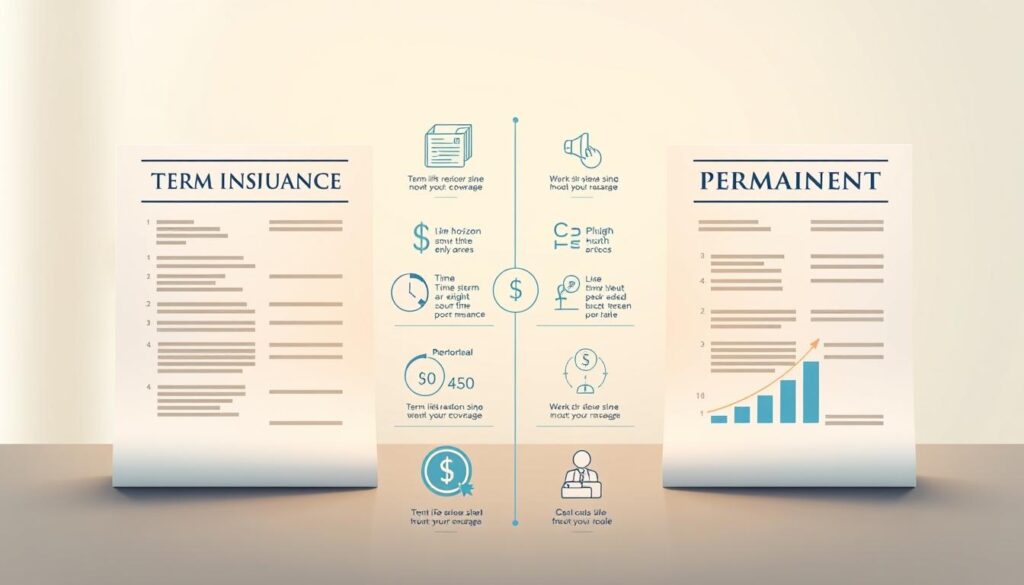
The tradeoff between price and long-term value shapes which coverage fits you best. One choice gives simple, low-cost protection for a set period. The other provides lifelong coverage and an account that can grow over time.
Term policies cost less because they only pay a death benefit during the term. You pick a number of years and pay level premiums for that span.
There is no cash value or account inside term contracts. If you want pure replacement protection while you earn or pay down debt, term often fits.
Permanent life insurance: Lifelong coverage with a cash value component
Permanent options funnel part of each premium into a cash value account. That value can grow, be borrowed against, or used later.
Whole life offers steady, guaranteed growth and fixed premiums. Universal variants let you change premium timing and credit interest, and variable universal choices put funds in subaccounts for higher growth risk.
“Buy term and invest the rest”: When this strategy may fit your needs
If you prefer lower upfront cost, you can choose term and put the difference into outside accounts. That approach works when you stay disciplined and aim for comparable long-term value growth.
- Compare rates and internal costs before deciding.
- Think about how long you need coverage and how you value liquidity versus predictable growth.
- Ask how each policy credits interest or investment returns performance drives future value.
| Feature | Term | Permanent |
|---|---|---|
| Premiums | Lower | Higher |
| Cash value | No | Yes |
| Coverage length | Set years | Lifelong |
Know your permanent policy options before you invest

Permanent coverage comes in several flavors, and each treats premiums, guarantees, and growth differently.
Whole life
Whole life insurance gives fixed premium schedules, a guaranteed death benefit, and steady cash value growth. You get predictability: the insurer promises minimum gains and stable costs.
Universal variants
Universal life insurance adds flexibility. You can change payments and, within limits, the death benefit. Credited rates can vary, so account value may shift with declared interest.
Indexed universal
Indexed universal links crediting to a market index. It usually has a floor to limit downside and a cap that limits upside. That creates a middle ground between guarantees and market performance.
Variable options
Variable life insurance and VUL let you invest the cash value in subaccounts. That can boost returns but brings market volatility and higher risk.
- Ask the insurance company how interest is credited and how often it resets.
- Review illustrations to see guaranteed versus projected growth and what portion of each premium funds costs versus value.
- Match the policy to your risk tolerance and the role you want this product to play in your broader plan.
| Type | Predictability | Growth potential |
|---|---|---|
| Whole life | High | Modest, guaranteed |
| Universal | Medium | Variable with declared rates |
| Variable / VUL | Low | High, market-driven |
How cash value grows over time and what affects performance

How your cash builds inside a policy depends on how you fund it and what crediting rules apply. That simple fact shapes early accumulation and long-term outcomes.
Single-pay and limited-pay designs front-load funds so your account grows faster in the first years. Ongoing, level premiums spread growth over many years.
Front-loading can boost early cash and reduce future outlay, but it may risk triggering MEC status. Always check tax rules before overfunding.
Rates, dividends, and policy mechanics
Account growth reflects declared rates, guarantees, or index returns. Whole life may pay dividends that buy paid-up additions and compound value.
- Watch internal expenses: early charges and the portion of each premium that covers cost of insurance reduce short-term growth.
- Monitor performance: review statements annually to see credited rate changes, caps, floors, or participation rules.
- Access planning: if you plan to withdraw money or take a loan later, build a larger buffer so the policy stays stable.
| Funding | Early cash | Tax note |
|---|---|---|
| Single-pay | High | Watch MEC risk |
| Limited-pay | Medium-high | Faster growth, possible limits |
| Level-pay | Gradual | Lower early costs |
In short, match your funding pace to goals, watch for fees and tax traps, and set review checkpoints every few years to confirm the strategy still meets your needs.
Smart ways you can access policy cash value without derailing coverage
Accessing the cash inside your policy can solve short-term gaps without surrendering protection. Each option affects the account, taxes, and the death benefit differently, so pick the method that matches your goal.
Policy loans
Policy loans let you borrow against cash value without immediate tax. Interest accrues, and any unpaid balance plus interest reduces the death benefit your beneficiaries receive. Ask your insurance company about fixed or variable loan rates.
Withdrawals
When you withdraw money, the IRS generally treats distributions as basis-first. That means returning up to your premiums is usually tax-free; gains above basis may be taxable and shrink the account value.
Using the policy as collateral
You may be able to pledge the contract to secure outside financing. This can help qualify for credit, but lenders may expect repayment from policy proceeds if a balance remains at death.
Accelerated benefits and surrender
Accelerated death benefit riders let you access a portion of the benefit for qualifying illness, often 25%–100% within rider limits. Surrendering returns cash value minus fees and ends coverage consider this only after comparing taxes and expenses.
| Access type | Tax | Impact on benefit |
|---|---|---|
| Policy loan | Generally tax-free now | Reduces death benefit if unpaid |
| Withdrawal | Basis-first, gains taxed | Reduces account value |
| Surrender | May trigger gain tax | Policy ends |
Tax implications, MEC pitfalls, and keeping your policy from lapsing
Understanding how access and funding affect taxes will protect both your cash and your death benefit. Your policy’s value grows tax-deferred, but withdrawals above your basis are generally taxed as ordinary income in the year you take them.
Watch overfunding: pay attention to premium timing. If you push too much money into a contract, it can convert to a modified endowment contract (MEC). Once a policy is a MEC, loans and withdrawals may be taxable and could incur penalties on early distributions.
Loan management and lapse prevention
Keep loan balances under control. If interest accrues and owed amounts approach total cash value, the policy can lapse and trigger a taxable event on gains.
- Pay loan interest on a schedule to limit compounding.
- Track credited rates and how charges change over time, especially with universal life insurance accounts.
- Document your basis and all access so taxes and reporting stay clean.
"Regular reviews help you spot funding or loan problems early and protect the death benefit you intend to leave."
| Issue | Action | Why it matters |
|---|---|---|
| MEC risk | Test funding; slow contributions | Avoids penalties and taxable withdrawals |
| Rising loan | Pay interest; reduce balance | Prevents lapse and taxable gain |
| Credited rates fall | Adjust premiums | Maintains account performance |
life insurance investment plans USA: A step-by-step way to choose what fits you
A step-by-step selection process cuts through jargon and helps you choose a policy you can afford long term.
Match risk tolerance and time horizon to the right policy type
Start by naming your risk comfort and how long you need coverage. If you want steady, predictable value, consider whole life. If you prefer flexibility with changing credited rates, look at universal variants.
Get side-by-side quotes that show premiums, fees, and projected performance. Ask for the insurer's ratings and recent dividend or crediting history.
Compare guarantees and expenses so you know what portion of each premium funds the account versus costs.
Align coverage amount, riders, and benefits with your needs and budget
Calculate the coverage that replaces income and covers debts, then add riders only if they fill real gaps. Keep your budget in mind and avoid costly add-ons that add little value.
When you need a buying primer, review a trusted guide on how to purchase a policy: how to buy life insurance.
- Match type to horizon: predictable for long horizons, flexible for changing needs.
- Check the company: ratings, claims service, and guarantees matter.
- Watch expenses: fees and caps affect cash value and long-term performance.
| Decision | Focus | Why it matters |
|---|---|---|
| Risk tolerance | Product type | Determines volatility and guarantees |
| Costs | Premiums & fees | Impacts net accumulation |
| Insurer | Financial strength | Protects guarantees and service |
Your next move: Build a protection-first plan that uses cash value wisely
Decide what protection must cover, then craft a path to build value without risking the benefit.
Define your protection goal first and set the coverage amount that replaces income and pays debts. Keep that floor firm before you commit extra money to grow cash inside the account.
Plan how you’ll fund premiums, when you might take a loan or withdrawal, and the tax tradeoffs if you access gains. Avoid overfunding that triggers MEC rules, and remember accelerated benefits and surrender carry costs and limits.
If market exposure appeals, consider variable life insurance cautiously and size the policy to your broader portfolio. For more on treating a policy as an asset, read about using a policy as a financial.
Set simple annual review dates, model large withdrawals, and monitor loan balances so your cash value supports the coverage you intend to leave behind.
🌿 Explore More Life Insurance Insights
View All Life Articles → Maximize Your Returns with High-Return Life Investment Insurance USA

Learn About Investment-Linked Policy Canada for Canadians

Life Insurance with Savings Option Australia: Secure Your Future

Secure Your Future with Unit-Linked Life Insurance UK Plans

Grow Your Wealth with wealth growth life insurance UK Plans
Go up
Leave a Reply