

Protect Your Home with Flood and Fire Insurance USA
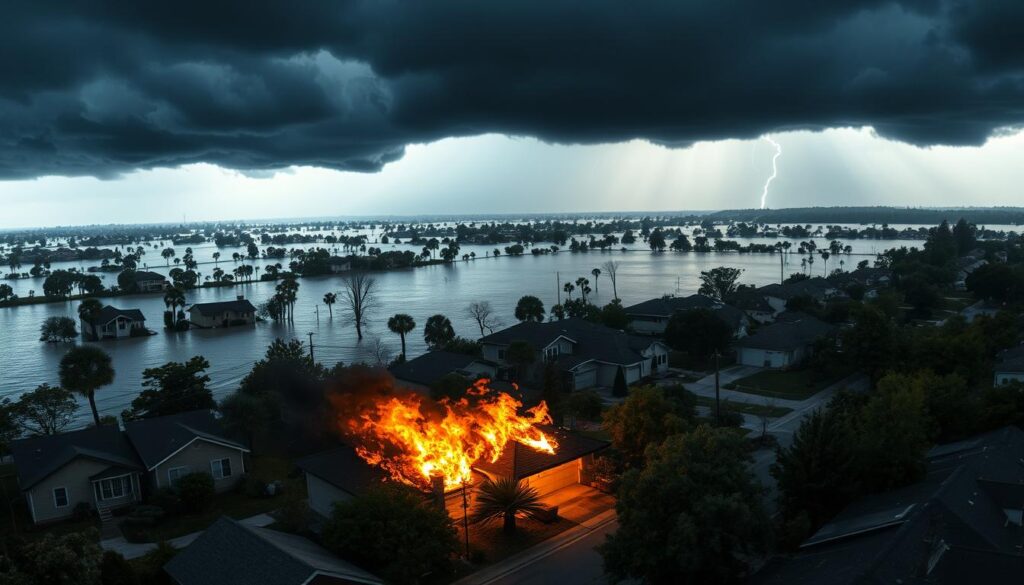
One inch of water can cost more than $25,000 in repairs a startling number that shows how quickly a small event can turn into a major loss for your house.
You need clear protection that fills gaps in a standard homeowners policy. Most plans don’t cover water-related perils like heavy rain, storm surge, or melting snow.
This guide helps you see why pairing water protection with strong fire coverage matters. You’ll learn about NFIP limits, typical waiting periods, and how claims often come from outside high-risk zones.
We’ll explain what counts as a flood under NFIP rules, how separate deductibles work, and why many carriers administer federal policies in your community.
Follow along to compare coverage types, plan limits, and timing so you can choose the right policy for your home and avoid costly surprises.
Table of Contents
- Why this Buyer’s Guide matters in the United States right now
- Understanding your risk: Flooding and fire exposures across the U.S.
- What homeowners insurance does and doesn’t cover for water and fire
- Do you need flood insurance? How to assess your property and lender requirements
- NFIP vs. private flood insurance: Coverage, limits, waiting periods, and trade-offs
- What a flood insurance policy covers (and what it doesn’t)
- Costs and savings: How premiums are calculated and today’s price landscape
- Timing matters: The waiting period and when to buy
- Top options to consider for flood coverage in the U.S. market
- Flood and fire insurance USA: Pairing policies for full home protection
- How to get a flood insurance quote and compare policies
- Your next steps to safeguard your home and belongings
Why this Buyer’s Guide matters in the United States right now
Today’s climate-driven losses make choosing the right protection urgent. Between 2014 and 2023, annual flood damage averaged about $46 billion. Experts project at least a 25% increase in losses over the next 25 years as climate trends intensify.
Standard home policies won’t cover many water events, yet roughly 22% of homeowners in high-risk zones lack a dedicated flood insurance policy. That gap creates real exposure to surprise repair bills and lost belongings.
You’ll use this guide to weigh coverage choices before severe weather strikes. We explain key cost drivers, from elevation and construction to deductible selections, so you know what shapes premium increases.
- See why national loss data matters: rising damage and claims push prices and availability.
- Spot coverage gaps: learn where a standard policy stops and a separate policy begins.
- Compare options: get a roadmap to match limits with your budget and risk.
Understanding your risk: Flooding and fire exposures across the U.S.
Risk maps offer a start, but your real exposure often depends on local features not shown on a flood map. Living outside a mapped high-risk flood zone does not remove your risk. More than 40% of NFIP claims come from areas labeled lower risk.
Flooding is the most common and costly natural disaster in the country. Average annual damage runs about $46 billion, and losses are expected to climb at least 25% over the next 25 years due to climate trends.
Local factors matter: soil saturation, drainage, nearby streams, and urban runoff can raise your threat even in a low-to-moderate area.
- Coastal vs. inland: Tidal surge risks differ from heavy-rain or snowmelt events that hit inland properties.
- Community effects: Repetitive loss zones and mitigation projects can change availability and pricing.
- Dual hazards: Drought-driven fire exposure can rise at the same time flash flood risks spike, so plan holistically.
Use these points to assess your property beyond a single map. Look at recent local claims come reports, elevation, and nearby drainage to gauge true exposure and pick the right coverage for your area.
What homeowners insurance does and doesn’t cover for water and fire
Knowing which water events your home policy will pay for can save you from surprise repair bills.
Most homeowner plans handle sudden internal losses. For example, a burst pipe or an accidental top-down roof leak is usually part of standard coverage.
When water comes up from outside — from rising surface levels or storm surge — that loss requires a separate flood insurance policy. That distinction matters for claims, payouts, and which deductible applies.
When internal leaks count
- Sudden pipe breaks: typically covered.
- Top-down rain into an attic or ceiling: often covered if accidental.
- Slow leaks from neglected maintenance: often excluded.
When you need a separate plan
Storm surge, overflowing waterways, or mudflow are outside most homeowners plans. You’ll need a dedicated flood insurance product for those losses.
| Feature | Homeowners policy | Separate flood policy |
|---|---|---|
| Source of water | Internal leaks, top-down rain | Rising surface water, surge, river overflow |
| Typical coverage | Structural repairs, some contents | Dwelling limits, contents limits |
| When to call your agent | After burst pipes or visible roof leaks | When external rising water threatens your lot |
Document damage quickly: take photos, save receipts, and call your agent right away to preserve your claim rights. For details on exclusions see what's not covered, and for homeowner options visit homeowners options.
Do you need flood insurance? How to assess your property and lender requirements
Start by checking whether your mortgage lender will require separate protection based on your property's mapped risk. Lenders often make coverage mandatory when a home sits in a FEMA-designated plain tied to your address.
Use the FEMA Flood Map Service Center to verify your lot. Enter your address, review the map panel, and note any special zones that trigger lender rules.
Mortgage rules in FEMA-designated zones
If your loan is tied to a property in a high-risk zone, your servicer may force purchase of a policy to protect the loan. Ask your officer what proof they accept to lift that requirement.
How to check your area
Look up your parcel at the FEMA map site and save a screenshot for your lender and agent. For details on lender-required coverage see this guide on lender-required coverage.
Why many claims come from outside high-risk zones
More than 40% of national flood program claims come from lower-risk areas. Local drainage, past intrusions, elevation, and nearby waterways often explain those losses.
- Check property signals: prior water marks, sump pump history, and lot slope.
- Watch shared spaces: condo master policies may not protect your contents fully.
- Balance cost vs. risk: compare potential out-of-pocket repairs to annual premiums.
Talk with your loan officer and agent using a short checklist: mapped status, lender demands, unit vs. master coverage, and estimated replacement costs. That will help you decide whether you need flood insurance now.
NFIP vs. private flood insurance: Coverage, limits, waiting periods, and trade-offs
Deciding between a government-backed plan and a private carrier starts with understanding fixed caps and flexible add-ons.
NFIP policies are underwritten by the federal emergency management authority and sold where communities participate. Rates are set nationally, which gives predictability but limits flexibility.
What NFIP gives you
The national flood insurance program caps dwelling at $250,000 and contents at $100,000. It generally excludes additional living expenses and personal property stored in basements.
What private carriers can add
Private options often offer higher limits, basement and pool protection, debris removal, and ALE. They may bundle deductibles so you carry one amount for building and contents.
- Stability: NFIP offers broad availability in participating towns.
- Flexibility: Private policies can be customized to your needs.
- Risk of declination: Private carriers may refuse very high-risk homes.
| Feature | NFIP (federal emergency management) | Private market |
|---|---|---|
| Dwelling limits | $250,000 | Often higher, subject to underwriting |
| Contents coverage | $100,000; basement items limited | Custom limits; basement and outdoor items possible |
| ALE & extras | Not included | Often available (temporary housing, debris removal) |
| Underwriting | National rates; community participation | Risk-based; may decline high-risk properties |
What helps pricing: elevation certificates, prior loss records, and clear photos. Bring those documents when you shop so you get accurate quotes.
What a flood insurance policy covers (and what it doesn’t)
Not all losses are equal some building parts are covered while others are excluded.
Covered structure items
Most plans pay to repair or replace key systems: electrical, plumbing, HVAC, appliances, cabinets, and flooring. These are part of the dwelling limit and have a separate deductible from personal property.
Contents coverage
Contents coverage protects many of your personal items. Limits differ from the building limit, so list high‑value belongings to set the right amount.
Common exclusions
- Earth movement and landslides.
- Currency, valuable papers, and collectibles.
- Decks, retaining walls, and swimming pools.
- Additional living expenses are usually not included.
Basement specifics
The basement often has limited protection. Service equipment like the water heater, furnace, washer, and dryer may be covered.
Finished walls, carpeting, and stored personal property in the basement are commonly excluded.
Tip: Keep a dated inventory and photos of rooms and items to speed claim evaluations and limit damage disputes.
Remember: structure and contents have separate limits and deductibles across policies. Talk with your agent to match limits to replacement costs and to avoid surprises at claim time.
Premiums reflect property details, not just maps. The average NFIP premium is about $786 per year. Your final cost depends on location, elevation, foundation type, construction materials, number of stories, and the policy limits you choose.
Location and mapped risk drive base rates. Elevation certificates usually lower price when they show your lowest floor above base level.
Foundation and materials matter. Raised homes and masonry walls tend to cost less to cover than slab foundations or wood frames.
Deductibles, contents choices, and private options
Higher deductibles reduce annual cost. Lower contents limits cut premium too but raise your out-of-pocket risk for belongings.
- Benchmark: expect roughly $786 per year for a standard NFIP plan.
- Rating factors: location, elevation, foundation, materials, story count.
- Shopping tip: some private carriers waive the elevation certificate requirement and offer multiple deductible choices.
- Value check: compare total coverage, exclusions, and extras like temporary living costs, not just price.
When you request a quote, bring accurate elevation and construction details to avoid repricing. For context on broader market pressure, read about how climate risk and pricing affect premiums today.
Timing matters: The waiting period and when to buy

When you buy a policy matters almost as much as the limits you pick. Most plans include a standard 30‑day waiting period before coverage starts. That gap exists to prevent last‑minute purchases tied to known loss events.
There are key exceptions at closing that can shorten or remove the delay. If your lender requires a purchase and you close in under 30 days, many carriers will bind a policy to match the closing date.
Private carriers sometimes offer faster start dates. Examples include Neptunelike programs with about 10 days, and other firms that bind in 7 days for non-loan closings. Rollovers from an existing plan also often remove waits.
| Item | Standard NFIP | Private options |
|---|---|---|
| Typical waiting | 30 days | 7–10 days, varies |
| Closing exception | Applies with lender proof | Often allowed, subject to carrier |
| Rollover from active policy | May waive wait | Usually immediate |
Quick checklist: align inspection dates, show closing proof, ask about rollovers, and buy well before storm season so your coverage and peace of mind start on time. For related homeowner guidance see property-owner options.
Top options to consider for flood coverage in the U.S. market
Market options range from standardized federal plans to tailored private offerings with high limits. Review each carrier's limits, wait times, and extras before you request a quote.
NFIP access through WYO carriers: The national flood insurance program is underwritten by FEMA and sold by Write-Your-Own firms like Amica, Liberty Mutual, Farmers, Nationwide, and GEICO. These carriers offer broad reach and consistent rates through the federal management agency.
Private standouts to compare
- Kin: Add-on in FL and LA, single deductible, no wait in FL.
- Aon Edge: EZ Flood up to $1.25M building/$875k contents; Excess up to $5M; four deductible choices; rates often ~40% below NFIP averages.
- Neptune: Dwelling to $4M; contents to $500k; basement and pool refill coverage; 10-day wait unless closing.
- Beyond Floods, Wright Flood, Chubb: Varying limits and extras such as replacement cost, single-deductible bundles, pool repair, and debris removal.
| Carrier type | Max dwelling | Contents limits | Key feature |
|---|---|---|---|
| WYO (NFIP) | $250,000 | $100,000 | Nationwide access via national program |
| Private (Aon Edge) | $5,000,000 | $875,000 | Higher limits, multiple deductibles |
| Private (Neptune) | $4,000,000 | $500,000 | Basement items, pool refill, 10-day start |
| Chubb | $15,000,000 | Combined limits | One deductible for home plus coverage extras |
How to use this list: Match limits to your replacement cost, check state availability for carriers like Kin and Beyond Floods, and ask whether an elevation certificate is required. Then request a quick quote to compare price, waiting period, and contents coverage before you buy a flood policy.
Flood and fire insurance USA: Pairing policies for full home protection

A clear plan for which policy pays first helps you avoid denied claims and billing fights.
Coordinate your homeowners policy with a separate flood policy to close coverage gaps. Private carriers such as Wright Flood and Chubb may offer a single deductible that applies across both claims. That can speed repairs and reduce out-of-pocket complexity.
NFIP-style plans usually keep separate deductibles for building and contents and do not include additional living expenses. In contrast, many private plans include ALE plus broader basement, pool, and external structure protection.
Single vs separate deductibles
Single deductible: simplifies billing when a single event causes mixed losses.
Separate deductibles: common under federal programs; you may face two deductibles after a loss.
Practical tips to avoid gaps
- Align limits: match building and contents totals across policies.
- Bundle where possible: same carrier can streamline claims handling.
- Document thoroughly: date photos, receipts, elevation data, and appliance serial numbers.
"Keep clear proof of ownership and condition to speed any claim payout."
How to get a flood insurance quote and compare policies
Getting an accurate flood insurance quote starts with a short checklist about your home.
Gather basic facts first: year built, foundation type, square footage, number of stories, prior losses, and any elevation data. These items speed an online quote and help agents match coverage to risk.
Gathering home details, selecting limits, and choosing contents coverage
Set building and contents limits to reflect replacement cost and valuables. Pick a deductible that balances premium and out‑of‑pocket risk.
Evaluating exclusions, additional living expenses, and basement coverage
Compare exclusions closely. Some policies exclude earth movement, decks, and pools. Private carriers may include ALE, basement contents coverage, and higher limits that NFIP plans lack.
- Request multiple quotes: use online portals for speed and call agents for complex homes.
- Watch timing: buy well before peak season to avoid waiting periods at closing.
- Payment: many federal plans require full payment at bind; private firms may offer installments.
| Feature | NFIP | Private |
|---|---|---|
| Limits | Standard caps | Higher, flexible |
| Basement items | Limited | Often covered |
| ALE | Usually no | Often yes |
Read the declarations page and endorsements to confirm the coverage you expect before you bind a policy. That protects your home and your belongings in your area.
Your next steps to safeguard your home and belongings
Begin with a short checklist that turns risk into clear next steps for your property.
Check FEMA maps for your lot, confirm lender requirements, then decide whether you need flood insurance now. Remember many claims come from outside mapped high‑risk zones.
Choose building and contents limits, and pick whether you want ALE or basement protection from private carriers. Expect average NFIP premiums near $786 per year and typical waiting periods unless purchase ties to a closing.
Get at least one quote from NFIP via WYO carriers such as Amica, Liberty Mutual, or GEICO and compare offers from private firms like Kin, Aon Edge, Neptune, Beyond Floods, Wright Flood, and Chubb.
Inventory your belongings, date photos, save receipts, then review this plan yearly so your coverage matches shifting climate and price trends.
🏠 Explore More Home Insurance Guides
View All Home Articles → Emergency Home Recovery Insurance USA: Get Covered

Natural Disaster Coverage Australia: Insurance for You

Is Your Home Covered? Storm Damage Home Insurance

Protect Your Home with Earthquake Insurance Canada
Protect Your Property with Disaster Protection for Landlords Australia
Go up
Leave a Reply